Mammal · Herbivore · Savanna
African elephant
Loxodonta africana
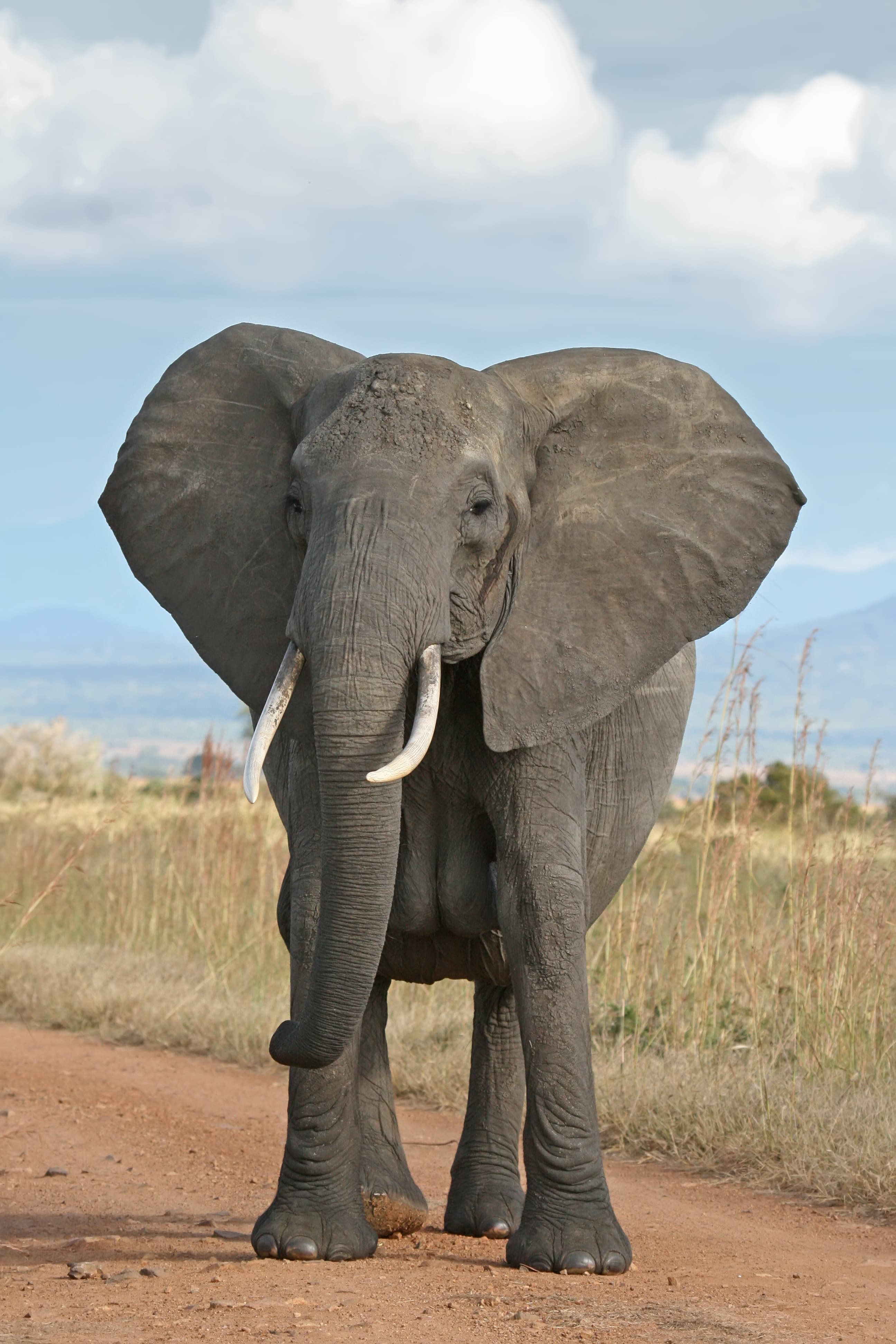
The African elephant is the largest living land mammal. Adults use their trunk for feeding, drinking, social contact and dust-bathing, and their large ears help dump heat in open, sunlit habitats. Family groups are led by experienced females and may travel long distances between water, forage and shade.
Interactive model
Characteristics
- 4,000–6,000 kg (adult)
- ≈ 8,818.5–13,227.7 lb (adult)
- 2.5–4 m (adult)
- ≈ 8.2–13.1 ft (adult)
- up to 40 km/h (maximum recorded)
- ≈ up to 24.9 mph (maximum recorded)
- 60–70 years
- ≈ 60–70 years
Typical adult range; large bulls can exceed this.
Short bursts
Scale
Bars are proportional to a linear dimension (height or length). They are not mass. Human reference is 1.7 m.
- African elephant3.3 m
- Average adult human1.7 m
- Double-decker bus4.4 m
- Two-storey house8 m
Activity: Mostly diurnal
Taxonomy
Life stages
Calf
0–4 year
Calves stay close to the natal family and rely on milk while learning routes to water and forage.
Juvenile
4–12 year
Independently feeding but still socially dependent on the family, especially during drought.
Adult
12–60 year
Sexually mature animals. Females typically remain with the family; males spend more time in bachelor groups or alone.
Older adult
50–∞ year
Long-lived individuals can retain landscape knowledge that benefits the whole family during scarce seasons.
Adaptations
Large, thin ears
Ear pinnae present a large surface rich in blood vessels. When an elephant flaps its ears, warmed blood sheds heat into the air, which is especially useful in hot, open habitats.
Trunk
The trunk is a fused nose and upper lip with extraordinary muscular control. It lets the animal pluck grasses, strip bark, suck water and investigate scents without kneeling.
Behaviour
Lives in multi-generational family groups centred on related females; males disperse as they mature.
Spends much of the day browsing and grazing; diet composition shifts with season and habitat.
Uses rumbling vocalisations, body posture and chemical cues; some calls travel long distances.
Habitat and range
- Africa (native)
- Southern Africa (native)
- Eastern Africa (native)
Regions
- Africa
- Southern Africa
- Eastern Africa
Simplified illustrative polygon for Southern and Eastern Africa. This is not an IUCN range map.
Conservation
Endangered
Population trend: Decreasing
Assessment year 2021 (curated, not live).
- Habitat loss and fragmentation
- Human–elephant conflict
- Illegal killing for ivory
Conservation depends on protected area networks, anti-poaching work, and corridors that keep seasonal movements possible. Status is curated from published IUCN assessments and should be re-checked against the source.
Source: Loxodonta africana. The IUCN Red List of Threatened Species
Compare
Sources
- Loxodonta africana. The IUCN Red List of Threatened Species — conservation
- Loxodonta africana African savanna elephant — measurement
- Loxodonta africana African savanna elephant — text
- AnAge entry for Loxodonta africana — measurement
- GBIF Backbone Taxonomy — Loxodonta africana — taxonomy
Photograph: Muhammad Mahdi Karim, Wikimedia Commons, CC BY-SA