Amphibian · Carnivore · Freshwater
Axolotl
Ambystoma mexicanum
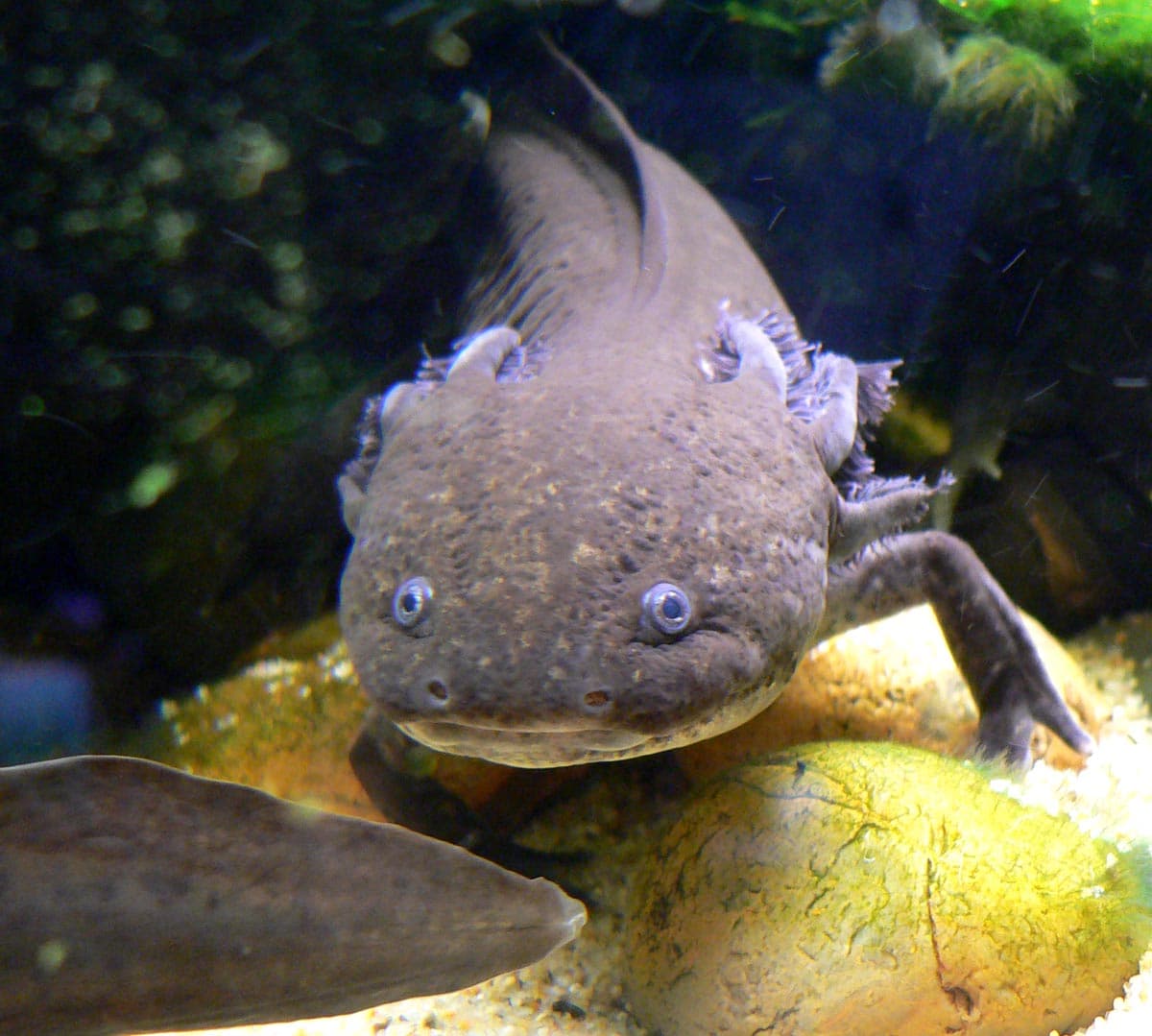
The axolotl is a paedomorphic salamander that typically retains larval features into adulthood. Wild populations are confined to remnant waters of the Mexico City basin and are critically endangered.
Interactive model
Characteristics
- 0.2–0.3 m (adult)
- ≈ 0.5–1 ft (adult)
- 0.1–0.1 kg (adult)
- ≈ 0.1–0.3 lb (adult)
- 10–15 years
- ≈ 10–15 years
Scale
Bars are proportional to a linear dimension (height or length). They are not mass. Human reference is 1.7 m.
- Axolotl0.2 m
- Basketball0.2 m
- Domestic cat0.3 m
- Average adult human1.7 m
Activity: Mostly nocturnal
Taxonomy
Life stages
Egg
Laid in water among plants.
Larva
Aquatic, gilled; this morphology is usually retained.
Paedomorphic adult
Sexually mature without a full terrestrial metamorphosis in most individuals.
Adaptations
Regeneration
Can regenerate limbs, gills and some internal tissues, making it a model for developmental biology.
Behaviour
Sucks in aquatic invertebrates and small vertebrates by rapid mouth expansion.
Habitat and range
- North America (native)
Conservation
Critically Endangered
Population trend: Decreasing
Assessment year 2019 (curated, not live).
- Habitat drainage
- Pollution
- Invasive fish
Source: Ambystoma mexicanum. The IUCN Red List of Threatened Species
Compare
Sources
- Ambystoma mexicanum. The IUCN Red List of Threatened Species — conservation
- Ambystoma mexicanum on Animal Diversity Web or equivalent secondary literature — measurement
- Ambystoma mexicanum on Animal Diversity Web or equivalent secondary literature — text
Photograph: Stan Shebs, Wikimedia Commons, CC BY_SA