Bird · Carnivore · Sea ice
Emperor penguin
Aptenodytes forsteri
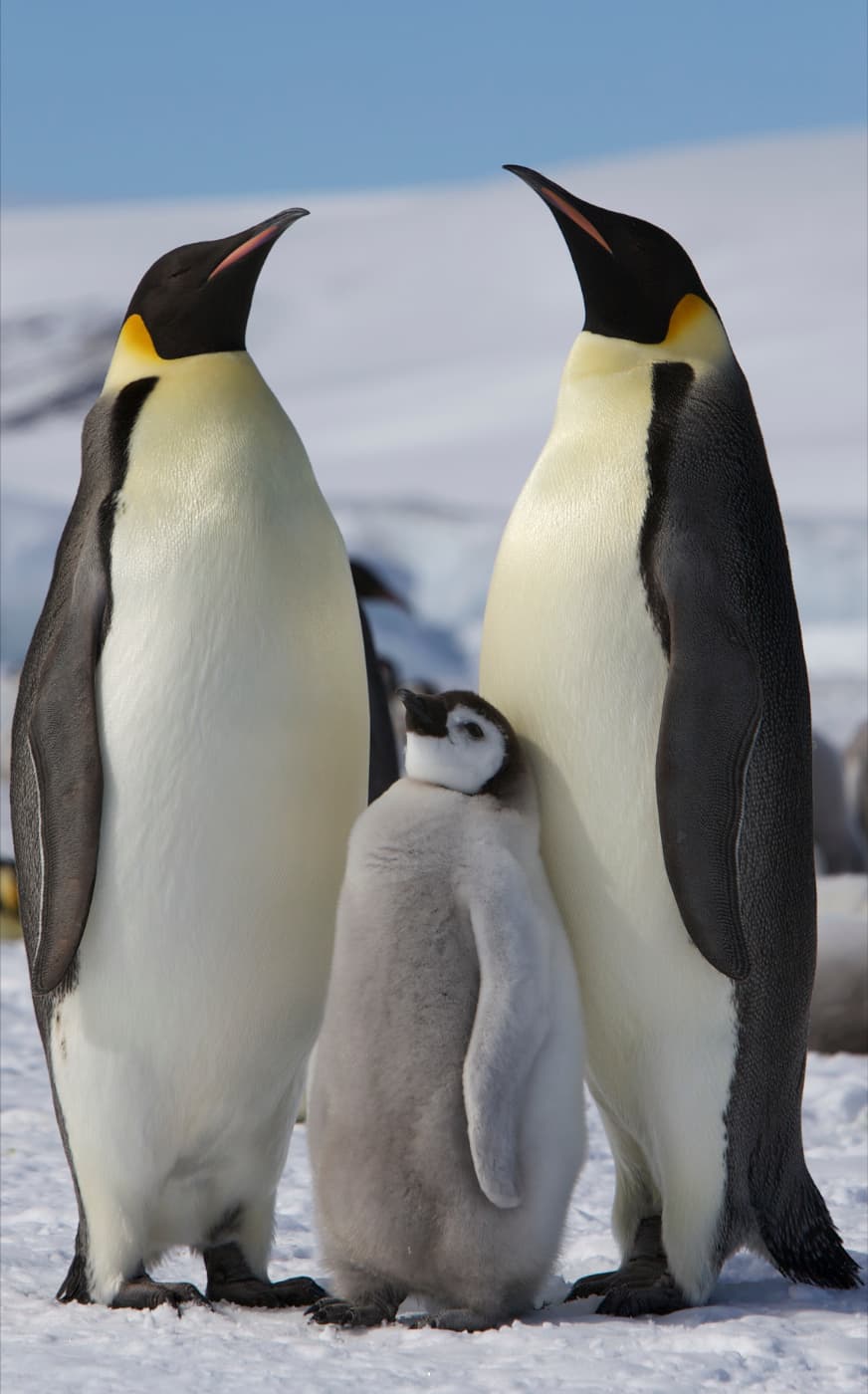
The emperor penguin breeds on Antarctic sea ice in winter. Males incubate the single egg on their feet while fasting through storms; chicks later form crèches.
Interactive model
Characteristics
- 1.1–1.3 m (adult)
- ≈ 3.6–4.3 ft (adult)
- 22–45 kg (adult)
- ≈ 48.5–99.2 lb (adult)
- 15–20 years
- ≈ 15–20 years
Scale
Bars are proportional to a linear dimension (height or length). They are not mass. Human reference is 1.7 m.
- Emperor penguin1.2 m
- Average adult human1.7 m
- Door2 m
Activity: Cathemeral
Taxonomy
Life stages
Egg
Incubated on the parent's feet under a brood pouch.
Chick
Downy chick fed regurgitated food; joins a crèche.
Adult
Walks long distances between colony and foraging leads.
Adaptations
Huddling and insulation
Dense plumage, fat and coordinated huddles reduce heat loss during Antarctic winter breeding.
Behaviour
Biparental care with a long male incubation fast.
Habitat and range
- Antarctica (native)
Conservation
Near Threatened
Population trend: Decreasing
Assessment year 2019 (curated, not live).
- Sea-ice change
- Prey shifts
Source: Aptenodytes forsteri. The IUCN Red List of Threatened Species
Compare
Sources
- Aptenodytes forsteri. The IUCN Red List of Threatened Species — conservation
- Aptenodytes forsteri on Animal Diversity Web or equivalent secondary literature — measurement
- Aptenodytes forsteri on Animal Diversity Web or equivalent secondary literature — text
Photograph: Ian Duffy, Wikimedia Commons, CC BY