Invertebrate · Carnivore · Marine
Giant Pacific octopus
Enteroctopus dofleini
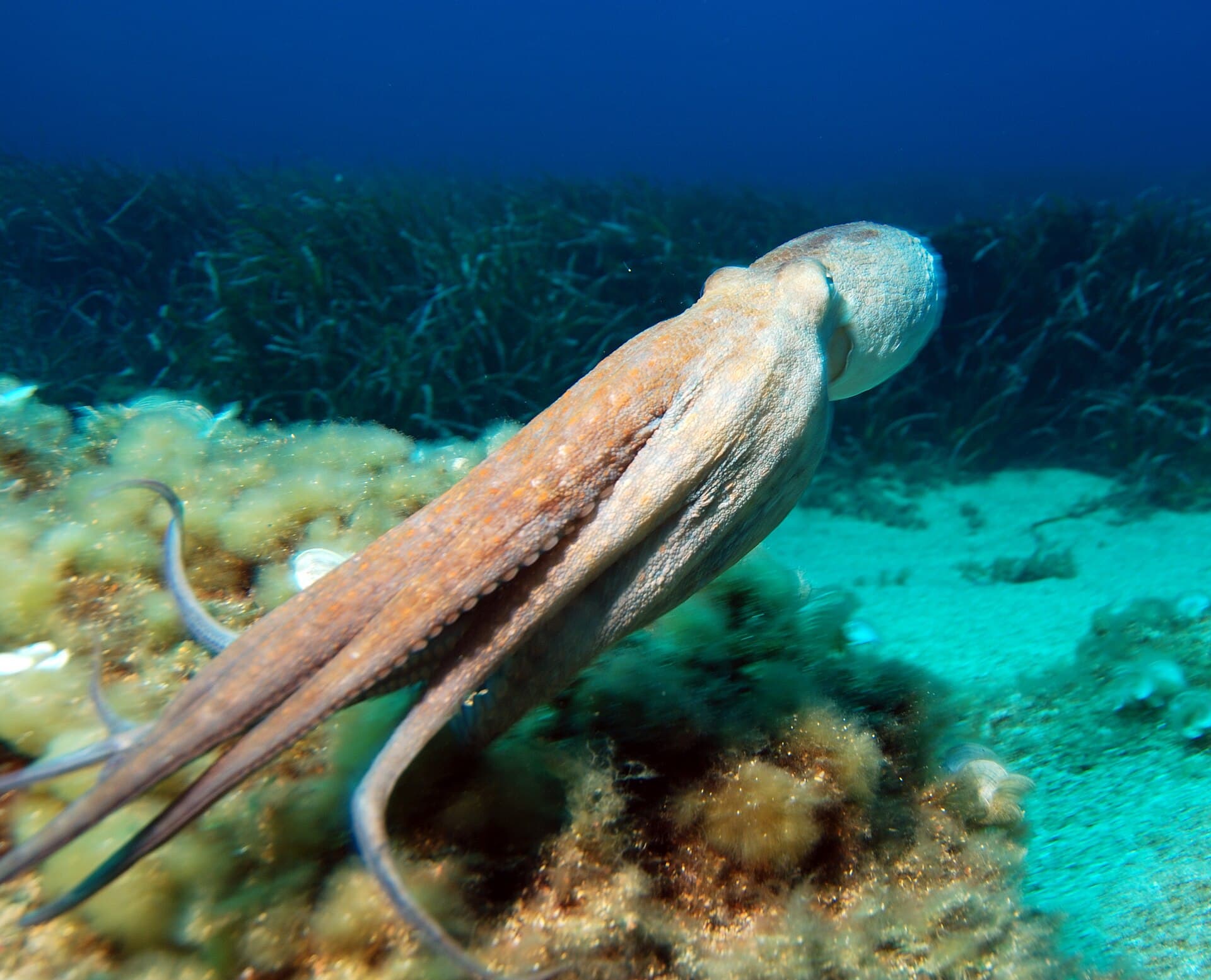
The giant Pacific octopus is a cold-water cephalopod with a relatively short adult life and a terminal reproductive event. It can change skin colour and texture for camouflage, and it uses a parrot-like beak to feed on crustaceans, molluscs and fishes.
Interactive model
Characteristics
- 15–50 kg (adult)
- ≈ 33.1–110.2 lb (adult)
- 3–5 m (adult)
- ≈ 9.8–16.4 ft (adult)
- 3–5 years
- ≈ 3–5 years
Exceptional individuals can exceed this range.
Arm span
Short for an animal of this size; tied to a single reproductive event.
Scale
Bars are proportional to a linear dimension (height or length). They are not mass. Human reference is 1.7 m.
- Giant Pacific octopus4 m
- Average adult human1.7 m
- Family car1.5 m
- Double-decker bus4.4 m
Activity: Mostly nocturnal
Taxonomy
Life stages
Egg
0–0.6 year
Females attach strings of eggs in a den and brood them, typically without feeding, until hatching.
Paralarva
0–0.3 year
Newly hatched animals are planktonic before settling to the benthos.
Juvenile
0–2 year
Bottom-living animals that occupy dens and grow rapidly in cold, productive waters.
Adult
2–5 year
Semelparous adults. After mating, the female broods eggs and usually dies around hatching; males also decline after reproduction.
Adaptations
Dynamic camouflage
Chromatophores, iridophores and papillae let the octopus match colour and texture of rock or kelp in seconds, which is central to both hunting and avoiding vertebrates with sharp vision.
Distributed nervous system
A large fraction of neurons sit in the arms. Arms can execute local grasping and exploration while the central brain coordinates hunting and den use.
Behaviour
Ambush and speculative foraging; prey is pulled into the web and bitten with a beak.
Females ventilate and guard eggs for months and typically do not resume feeding.
Largely solitary; interactions are mainly mating or den disputes.
Habitat and range
- North Pacific (native)
- North America (native)
- Asia (native)
Regions
- North Pacific
- North America
- Asia
Simplified North Pacific polygon. Not a bathymetric distribution map.
Conservation
Least Concern
Population trend: Unknown
Assessment year 2014 (curated, not live).
- Localised harvest
- Benthic habitat disturbance
Fisheries management varies by region; global status remains least concern in published assessments.
Source: Enteroctopus dofleini. The IUCN Red List of Threatened Species
Compare
Sources
- Enteroctopus dofleini. The IUCN Red List of Threatened Species — conservation
- Enteroctopus dofleini giant Pacific octopus — measurement
- Enteroctopus dofleini giant Pacific octopus — text
- AnAge entry for Enteroctopus dofleini — measurement
Photograph: Albert Kok, Wikimedia Commons, CC BY-SA