Mammal · Herbivore · Temperate forest
Giant panda
Ailuropoda melanoleuca
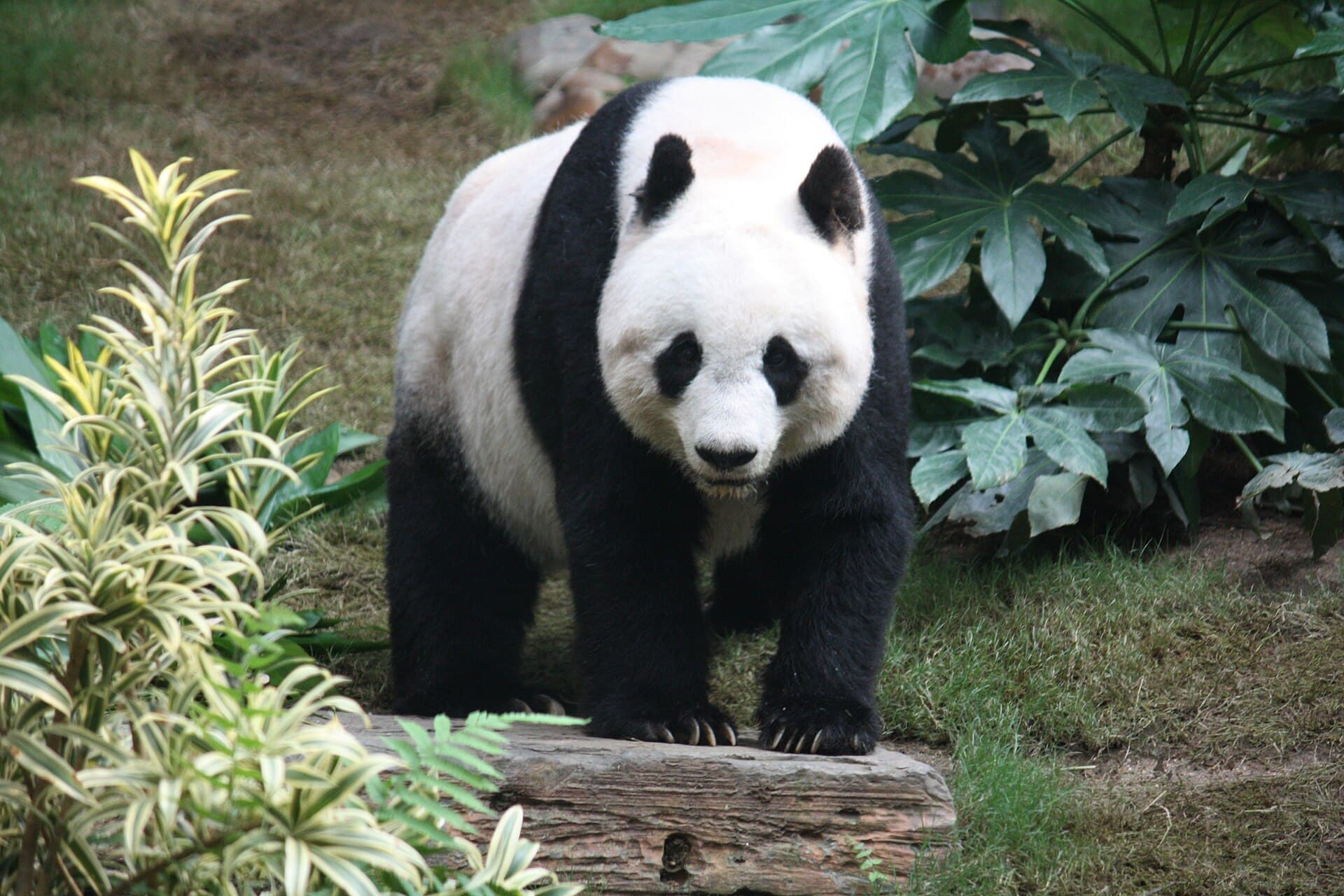
The giant panda is a bear specialised on bamboo in montane forests of China. A carnivoran gut plus a ‘false thumb’ let it process a low-nutrient plant diet for most of the day.
Interactive model
Characteristics
- 70–125 kg (adult)
- ≈ 154.3–275.6 lb (adult)
- 1.2–1.8 m (adult)
- ≈ 3.9–5.9 ft (adult)
- 15–20 years
- ≈ 15–20 years
Scale
Bars are proportional to a linear dimension (height or length). They are not mass. Human reference is 1.7 m.
- Giant panda1.5 m
- Average adult human1.7 m
- Family car1.5 m
- Double-decker bus4.4 m
Activity: Cathemeral
Taxonomy
Life stages
Cub
Altricial and tiny at birth relative to the mother; dens in tree hollows or caves.
Adult
Mostly solitary except during a short mating season; days are dominated by feeding.
Adaptations
Radial sesamoid ‘thumb’
An enlarged wrist bone opposes the paw and helps grasp bamboo culms — a feeding tool, not a true digit.
Behaviour
Eats tens of kilograms of bamboo daily; still an occasional scavenger or predator.
Scent marks advertise occupancy; ranges overlap more than in many solitary carnivores.
Habitat and range
- Asia (native)
Conservation
Vulnerable
Population trend: Increasing
Assessment year 2016 (curated, not live).
- Habitat fragmentation
- Bamboo flowering cycles
Source: Ailuropoda melanoleuca. The IUCN Red List of Threatened Species
Compare
Sources
- Ailuropoda melanoleuca. The IUCN Red List of Threatened Species — conservation
- Ailuropoda melanoleuca on Animal Diversity Web or equivalent secondary literature — measurement
- Ailuropoda melanoleuca on Animal Diversity Web or equivalent secondary literature — text
Photograph: J. Patrick Fischer, Wikimedia Commons, CC BY-SA