Amphibian · Insectivore · Tropical rainforest
Golden poison frog
Phyllobates terribilis
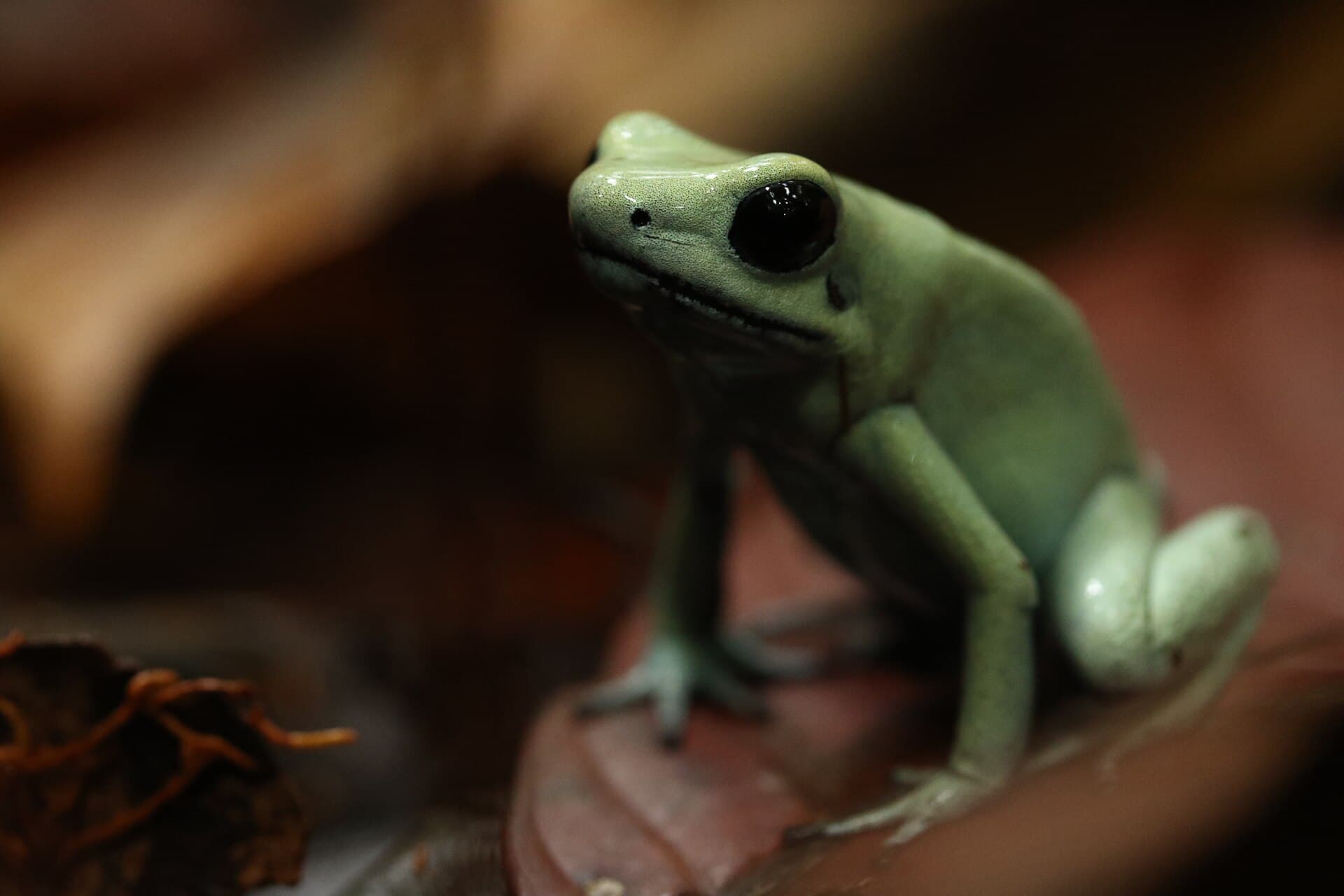
The golden poison frog is a diurnal dendrobatid of Colombian rainforest. Wild toxicity comes from dietary alkaloids; captive-bred frogs lacking those prey are not comparably toxic.
Interactive model
Characteristics
- 0–0.1 m (adult)
- ≈ 0.1–0.2 ft (adult)
- 0 kg (adult)
- ≈ 0.1 lb (adult)
- 5–10 years
- ≈ 5–10 years
Scale
Bars are proportional to a linear dimension (height or length). They are not mass. Human reference is 1.7 m.
- Golden poison frog0.1 m
- 2 pence coin0 m
- Human hand0.2 m
- Average adult human1.7 m
Activity: Mostly diurnal
Taxonomy
Life stages
Egg
Terrestrial eggs; males often transport tadpoles to water.
Tadpole
Aquatic larva before metamorphosis.
Adult
Diurnal, territorial frog with aposematic colouration.
Adaptations
Dietary alkaloids
Batrachotoxins acquired from arthropod prey make wild frogs dangerous to handle; colour advertises the defence.
Behaviour
Males typically carry tadpoles to small water bodies.
Habitat and range
- South America (native)
Conservation
Endangered
Population trend: Decreasing
Assessment year 2017 (curated, not live).
- Habitat loss
- Illegal collection
Source: Phyllobates terribilis. The IUCN Red List of Threatened Species
Compare
Sources
- Phyllobates terribilis. The IUCN Red List of Threatened Species — conservation
- Phyllobates terribilis on Animal Diversity Web or equivalent secondary literature — measurement
- Phyllobates terribilis on Animal Diversity Web or equivalent secondary literature — text
Photograph: Biodiego88, Wikimedia Commons, CC BY