Fish · Carnivore · Marine
Great white shark
Carcharodon carcharias
The great white shark is a wide-ranging lamnid predator of marine mammals, fishes and scavenged whales. It is fully aquatic and regional endothermy supports bursts of high performance in cool water.
Interactive model
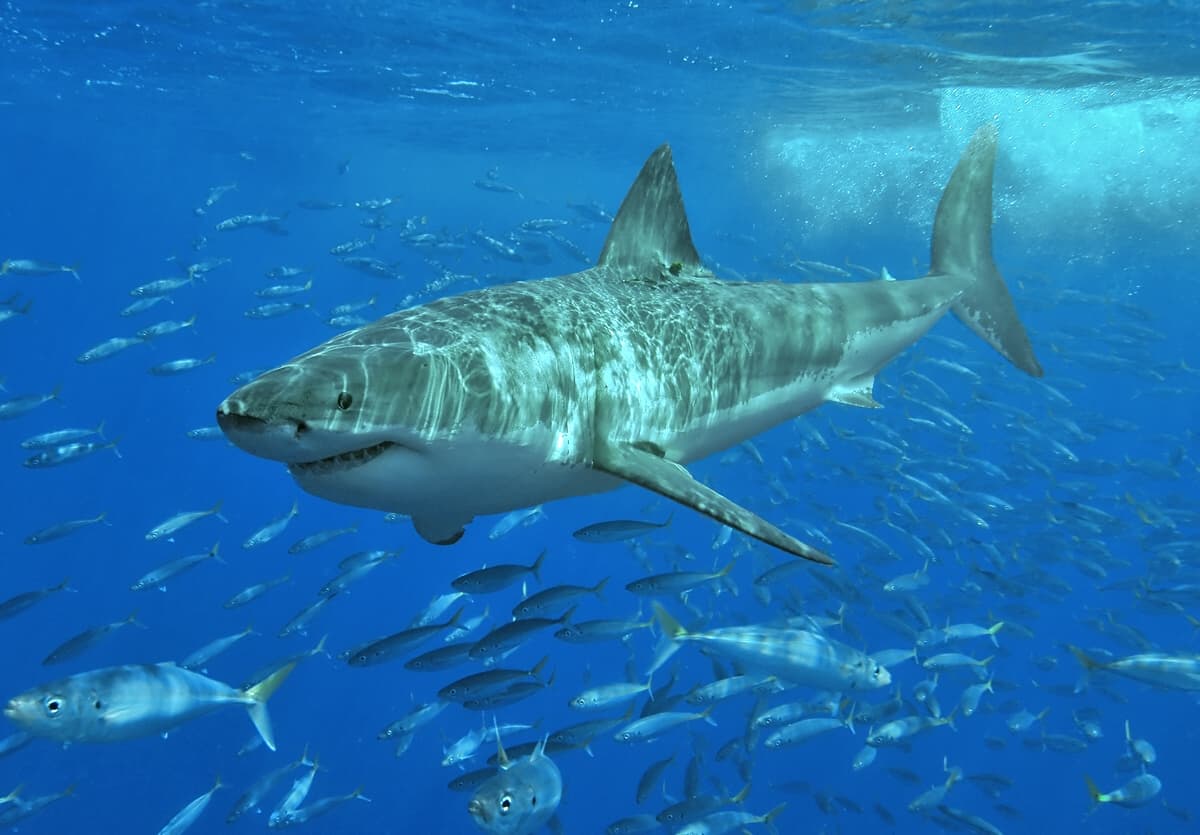
Characteristics
- 4–6 m (adult)
- ≈ 13.1–19.7 ft (adult)
- 680–1,100 kg (adult)
- ≈ 1,499.1–2,425.1 lb (adult)
- up to 56 km/h (maximum recorded)
- ≈ up to 34.8 mph (maximum recorded)
- 30–70 years
- ≈ 30–70 years
Scale
Bars are proportional to a linear dimension (height or length). They are not mass. Human reference is 1.7 m.
- Great white shark5 m
- Average adult human1.7 m
- Double-decker bus4.4 m
- Two-storey house8 m
Activity: Cathemeral
Taxonomy
Life stages
Juvenile
Feeds more on fishes; uses nursery areas in some regions.
Adult
Takes larger prey including pinnipeds where available.
Adaptations
Regional endothermy
Vascular heat exchangers keep swimming muscles warmer than ambient water, supporting sustained cruising.
Behaviour
Ambush from below is documented at some seal colonies; diet is broader than that stereotype.
Habitat and range
- Global ocean (native)
Conservation
Vulnerable
Population trend: Decreasing
Assessment year 2018 (curated, not live).
- Bycatch
- Direct fishing
Source: Carcharodon carcharias. The IUCN Red List of Threatened Species
Compare
Sources
- Carcharodon carcharias. The IUCN Red List of Threatened Species — conservation
- Carcharodon carcharias on Animal Diversity Web or equivalent secondary literature — measurement
- Carcharodon carcharias on Animal Diversity Web or equivalent secondary literature — text
Photograph: Terry Goss, Wikimedia Commons, CC BY_SA