Reptile · Herbivore · Marine
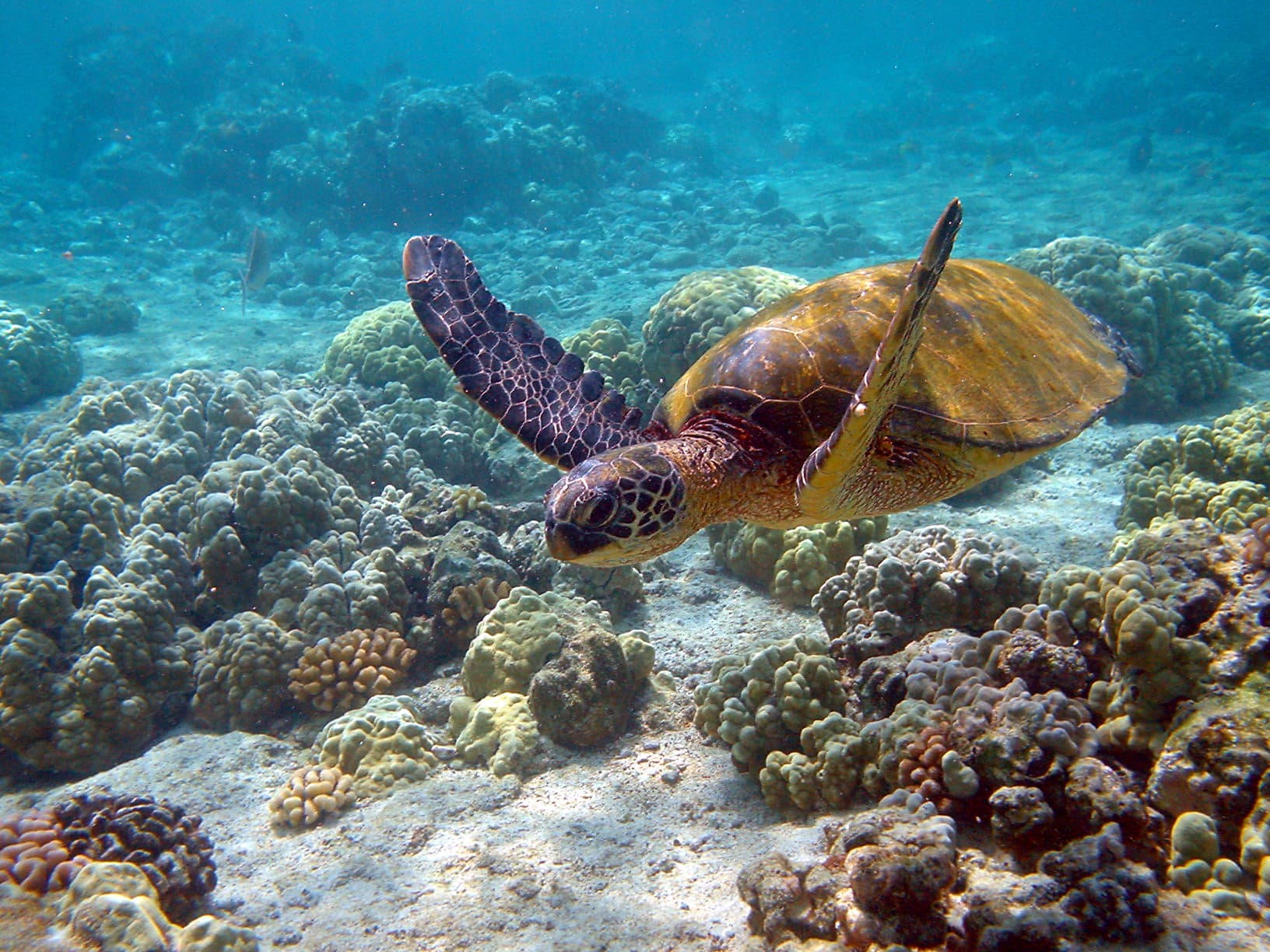
Green sea turtle
Chelonia mydas
The green sea turtle is a wide-ranging marine reptile. Adults in many populations feed largely on seagrasses and algae, while juveniles are more omnivorous. Females return to natal region beaches to nest, linking distant foraging grounds with specific coastlines.
Interactive model
Characteristics
- 110–190 kg (adult)
- ≈ 242.5–418.9 lb (adult)
- 0.8–1.2 m (adult)
- ≈ 2.6–3.9 ft (adult)
- up to 35 km/h (maximum recorded)
- ≈ up to 21.7 mph (maximum recorded)
- 60–80 years
- ≈ 60–80 years
Straight carapace length
Short swimming bursts; routine speeds are much lower.
Scale
Bars are proportional to a linear dimension (height or length). They are not mass. Human reference is 1.7 m.
- Green sea turtle1 m
- Average adult human1.7 m
- Family car1.5 m
- Double-decker bus4.4 m
Activity: Mostly diurnal
Taxonomy
Life stages
Egg
0–0.2 year
Eggs incubate in a sandy nest. Temperature during incubation influences hatchling sex ratio.
Hatchling
0–0.1 year
Hatchlings emerge together and crawl to the sea, then enter a largely pelagic early life.
Juvenile
0–20 year
Recruits into neritic foraging habitats; diet is typically more omnivorous than in adults.
Adult
20–∞ year
Sexually mature turtles migrate between foraging areas and nesting beaches, often over long distances.
Adaptations
Flippers instead of walking limbs
Forelimbs are modified as hydrofoils. In water they provide lift and thrust; on land they are awkward, so nesting is a costly, brief terrestrial event.
Salt glands
Specialised glands near the eyes excrete excess salt, allowing the turtle to drink seawater and eat marine plants without dehydrating.
Behaviour
Adults may travel hundreds to thousands of kilometres between feeding grounds and nesting beaches.
Many adult populations graze seagrass and algae; this grazing can influence meadow structure.
Females typically nest at night, laying multiple clutches in a season, then skip years between nesting.
Habitat and range
- Tropical oceans (native)
- Atlantic Ocean (native)
- Pacific Ocean (native)
- Indian Ocean (native)
Regions
- Tropical oceans
- Atlantic Ocean
- Pacific Ocean
- Indian Ocean
Simplified tropical ocean belt. Not a nesting-beach inventory or IUCN spatial layer.
Conservation
Endangered
Population trend: Decreasing
Assessment year 2023 (curated, not live).
- Fisheries bycatch
- Harvest of eggs and turtles
- Coastal development on nesting beaches
- Climate-driven nest heating
Nest protection, bycatch reduction, and international trade controls are central conservation tools.
Source: Chelonia mydas. The IUCN Red List of Threatened Species
Compare
Sources
- Chelonia mydas. The IUCN Red List of Threatened Species — conservation
- Chelonia mydas green sea turtle — measurement
- Chelonia mydas green sea turtle — text
- AnAge entry for Chelonia mydas — measurement
Photograph: Brocken Inaglory, Wikimedia Commons, CC BY-SA