Mammal · Carnivore · Temperate forest
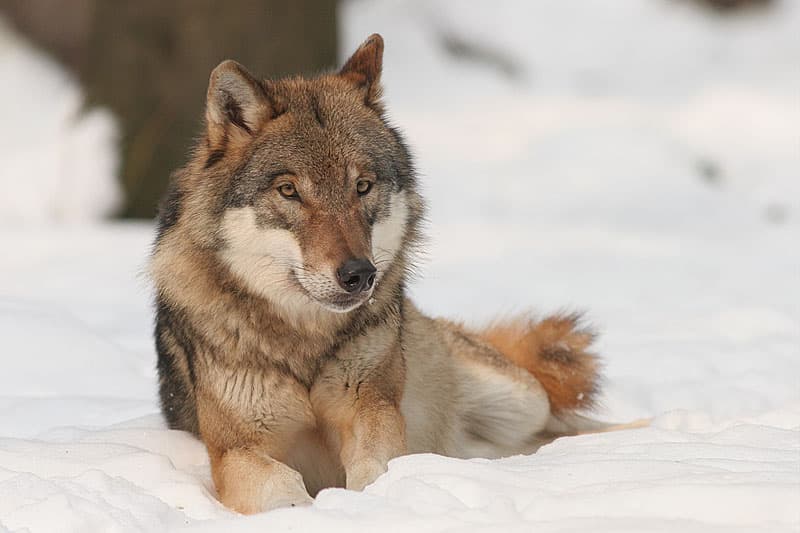
Grey wolf
Canis lupus
The grey wolf is a wide-ranging canid that hunts in packs where prey and snow conditions favour cooperation. Subspecies and dog domestication make the taxonomy historically contested; Fauna treats the wild wolf as Canis lupus.
Interactive model
Characteristics
- 23–55 kg (adult)
- ≈ 50.7–121.3 lb (adult)
- 1–1.6 m (adult)
- ≈ 3.3–5.2 ft (adult)
- up to 64 km/h (maximum recorded)
- ≈ up to 39.8 mph (maximum recorded)
- 6–13 years
- ≈ 6–13 years
Scale
Bars are proportional to a linear dimension (height or length). They are not mass. Human reference is 1.7 m.
- Grey wolf1.3 m
- Average adult human1.7 m
- Door2 m
Activity: Crepuscular
Taxonomy
Life stages
Pup
Born in dens; provisioned by the pack.
Yearling
Learns hunting routes and may disperse.
Adult
Breeding is usually limited to a dominant pair in a pack.
Adaptations
Endurance gait
Long legs and a cursorial body plan support covering large home ranges in search of ungulate prey.
Behaviour
Packs are typically family groups; size tracks prey size and habitat.
Howls, scent marks and body language coordinate spacing and reunions.
Habitat and range
- North America (native)
- Europe (native)
- Asia (native)
Conservation
Least Concern
Population trend: Stable
Assessment year 2018 (curated, not live).
- Persecution
- Habitat fragmentation
Source: Canis lupus. The IUCN Red List of Threatened Species
Compare
Sources
- Canis lupus. The IUCN Red List of Threatened Species — conservation
- Canis lupus on Animal Diversity Web or equivalent secondary literature — measurement
- Canis lupus on Animal Diversity Web or equivalent secondary literature — text
Photograph: Bernard Landgraf, Wikimedia Commons, CC BY-SA