Mammal · Herbivore · Freshwater
Hippopotamus
Hippopotamus amphibius
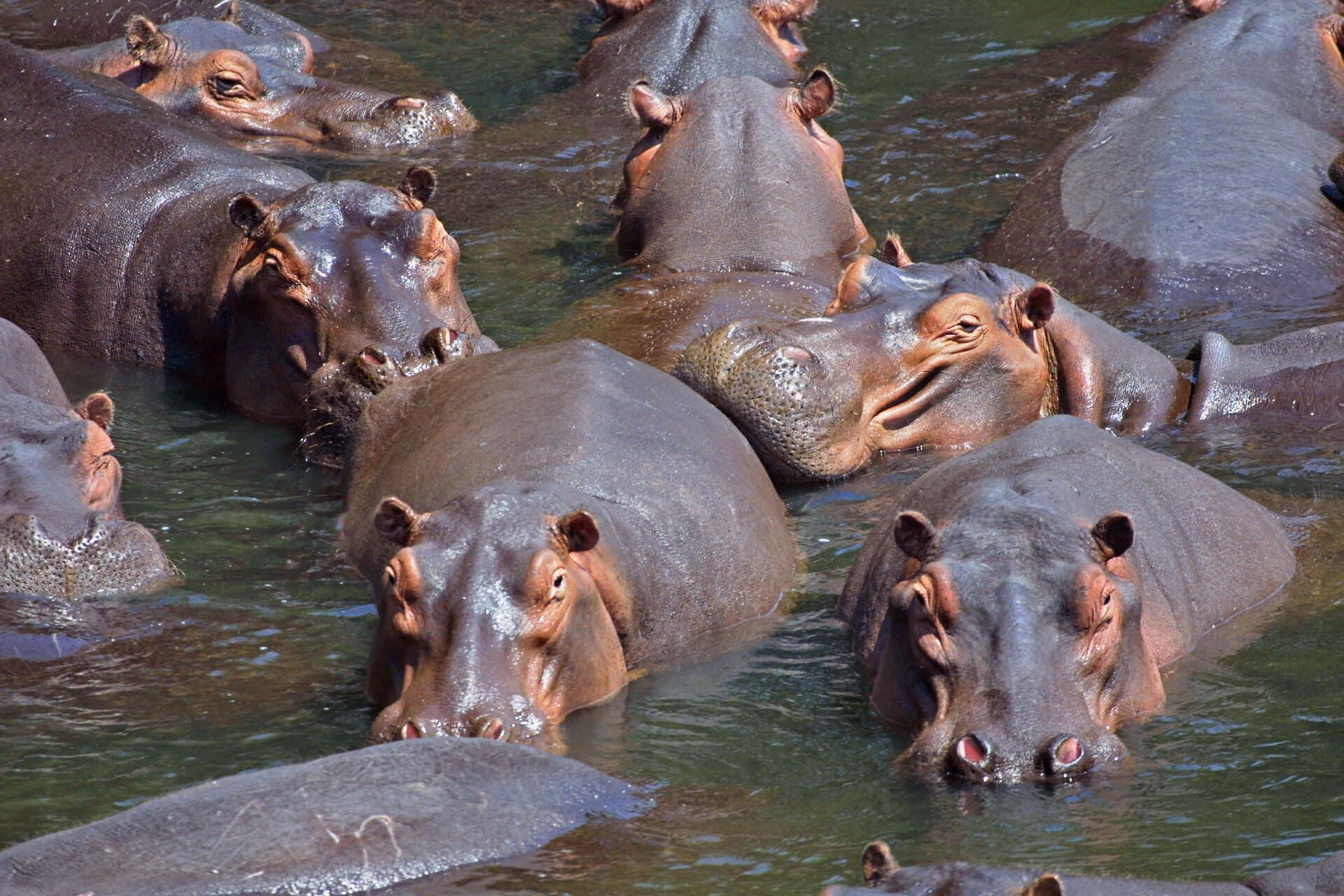
The common hippopotamus is a large African ungulate that spends days in water and grazes on land at night. Territorial males defend stretches of river; most feeding is terrestrial grass, not aquatic plants.
Interactive model
Characteristics
- 1,300–1,800 kg (adult)
- ≈ 2,866–3,968.3 lb (adult)
- 2.9–5 m (adult)
- ≈ 9.5–16.4 ft (adult)
- 35–50 years
- ≈ 35–50 years
Scale
Bars are proportional to a linear dimension (height or length). They are not mass. Human reference is 1.7 m.
- Hippopotamus4 m
- Average adult human1.7 m
- Double-decker bus4.4 m
- Two-storey house8 m
Activity: Mostly nocturnal
Taxonomy
Life stages
Calf
Nurses underwater and on land; stays close to the mother in pods.
Adult
Males may hold river territories; females and young form groups.
Adaptations
Semi-aquatic body
Dense bone, high-set eyes and nostrils, and skin that needs moisture let hippos rest in water while remaining alert.
Behaviour
Leaves water at dusk to graze grasses, often several kilometres inland.
Pods form in water; fights among males can be severe.
Habitat and range
- Africa (native)
Conservation
Vulnerable
Population trend: Decreasing
Assessment year 2016 (curated, not live).
- Habitat loss
- Unregulated hunting
- Drought
Source: Hippopotamus amphibius. The IUCN Red List of Threatened Species
Compare
Sources
- Hippopotamus amphibius. The IUCN Red List of Threatened Species — conservation
- Hippopotamus amphibius on Animal Diversity Web or equivalent secondary literature — measurement
- Hippopotamus amphibius on Animal Diversity Web or equivalent secondary literature — text
Photograph: Paul Maritz, Wikimedia Commons, CC BY_SA