Invertebrate · Nectarivore · Grassland and meadow
Western honey bee
Apis mellifera
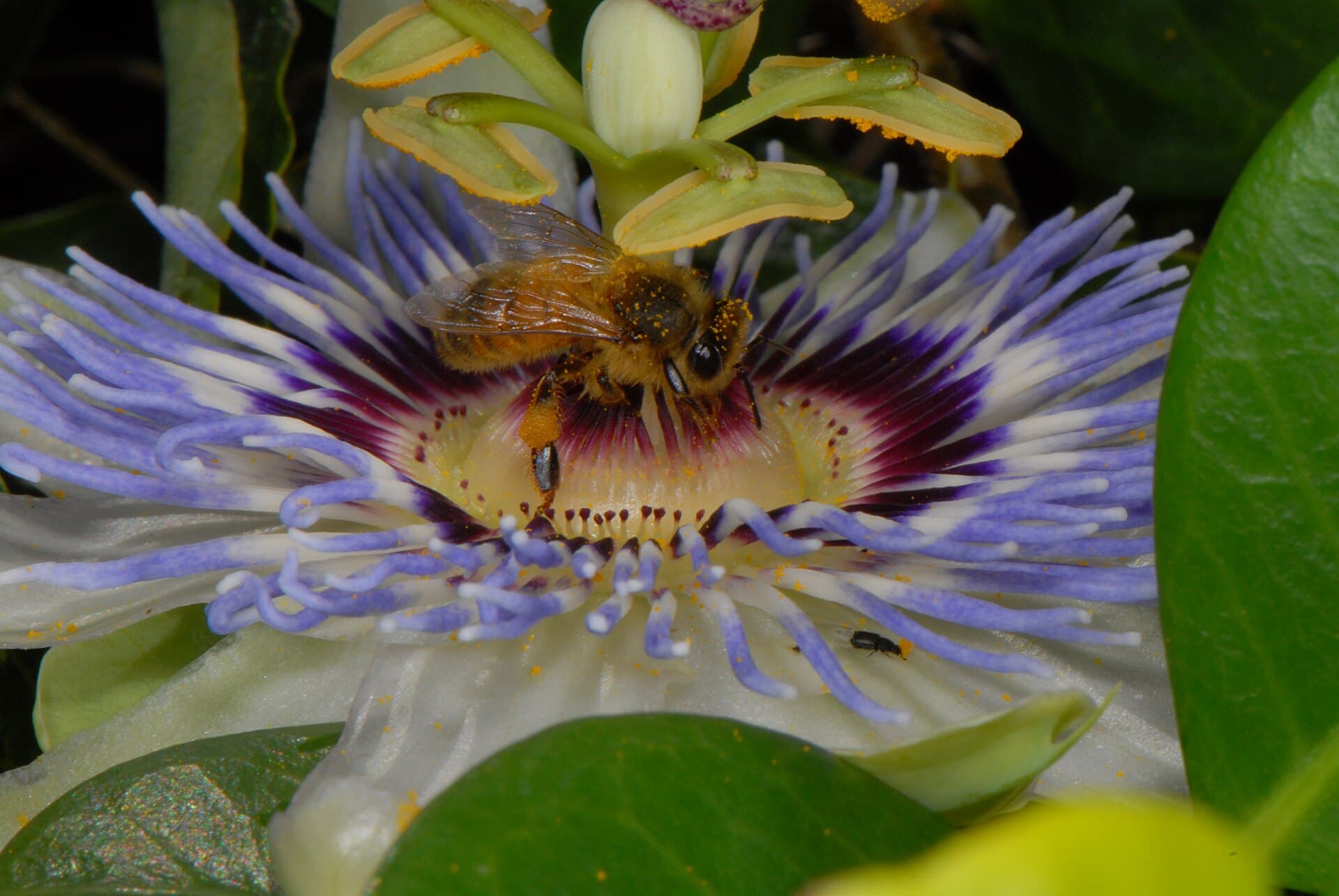
The western honey bee is a eusocial insect managed worldwide for honey and crop pollination. Wild and feral colonies still exist, but parasites and landscape change affect health. This is not a native-everywhere species; humans moved it globally.
Interactive model
Characteristics
- 0–0 m (adult)
- ≈ 0–0.1 ft (adult)
- 0 kg (adult)
- ≈ 0 lb (adult)
- 0–0.2 years
- ≈ 0–0.2 years
Workers in summer live weeks; queens live years.
Scale
Bars are proportional to a linear dimension (height or length). They are not mass. Human reference is 1.7 m.
- Western honey bee0 m
- 2 pence coin0 m
- Human hand0.2 m
- Average adult human1.7 m
Activity: Mostly diurnal
Taxonomy
Life stages
Egg
Laid in wax cells by the queen.
Larva
Fed royal jelly then pollen and honey depending on caste.
Pupa
Metamorphoses inside a capped cell.
Adult
Workers, drones and a queen with strongly different roles.
Adaptations
Waggle dance
Returning foragers encode direction and distance to resources, a rare example of symbolic communication in insects.
Behaviour
Colony is a superorganism with division of labour and overlapping generations.
Habitat and range
- Africa (native)
- Europe (native)
- Asia (native)
- North America (introduced)
Conservation
Data Deficient
Population trend: Unknown
Assessment year 2019 (curated, not live).
- Parasites
- Pesticides
- Floral scarcity
Source: Apis mellifera. The IUCN Red List of Threatened Species
Compare
Sources
- Apis mellifera. The IUCN Red List of Threatened Species — conservation
- Apis mellifera on Animal Diversity Web or equivalent secondary literature — measurement
- Apis mellifera on Animal Diversity Web or equivalent secondary literature — text
Photograph: Sam Fraser-Smith, Wikimedia Commons, CC BY