Reptile · Carnivore · Tropical forest
King cobra
Ophiophagus hannah
The king cobra is the longest venomous snake, a forest elapid of South and Southeast Asia that specialises on other snakes. It is not a true cobra (Naja) despite the hood display.
Interactive model
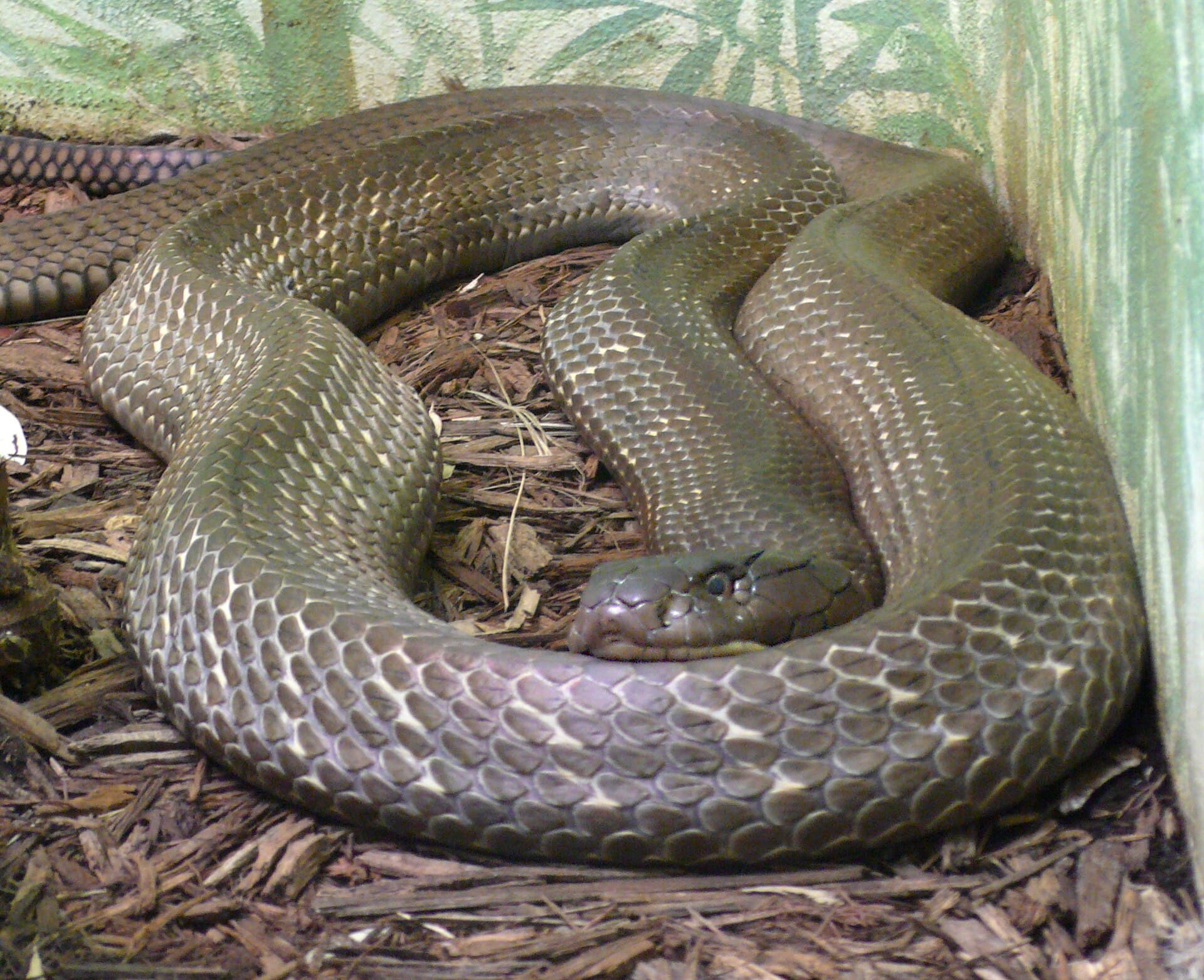
Characteristics
- 3–5.5 m (adult)
- ≈ 9.8–18 ft (adult)
- 5–12 kg (adult)
- ≈ 11–26.5 lb (adult)
- 15–20 years
- ≈ 15–20 years
Scale
Bars are proportional to a linear dimension (height or length). They are not mass. Human reference is 1.7 m.
- King cobra4.3 m
- Average adult human1.7 m
- Family car1.5 m
- Double-decker bus4.4 m
Activity: Mostly diurnal
Taxonomy
Life stages
Hatchling
Independent from hatching; venomous from the first meal of small snakes.
Adult
Females may guard a nest of vegetation; adults are largely solitary.
Adaptations
Ophiophagous diet
A skull and venom suited to subduing other snakes, including other elapids, reduce competition with generalist predators.
Behaviour
Primarily eats snakes; lizards and rodents are occasional.
Builds and may attend a nest of leaf litter — unusual among snakes.
Habitat and range
- Asia (native)
Conservation
Vulnerable
Population trend: Decreasing
Assessment year 2011 (curated, not live).
- Habitat loss
- Persecution
- Collection
Source: Ophiophagus hannah. The IUCN Red List of Threatened Species
Compare
Sources
- Ophiophagus hannah. The IUCN Red List of Threatened Species — conservation
- Ophiophagus hannah on Animal Diversity Web or equivalent secondary literature — measurement
- Ophiophagus hannah on Animal Diversity Web or equivalent secondary literature — text
Photograph: TimVickers, Wikimedia Commons, PUBLIC DOMAIN