Reptile · Carnivore · Savanna
Komodo dragon
Varanus komodoensis
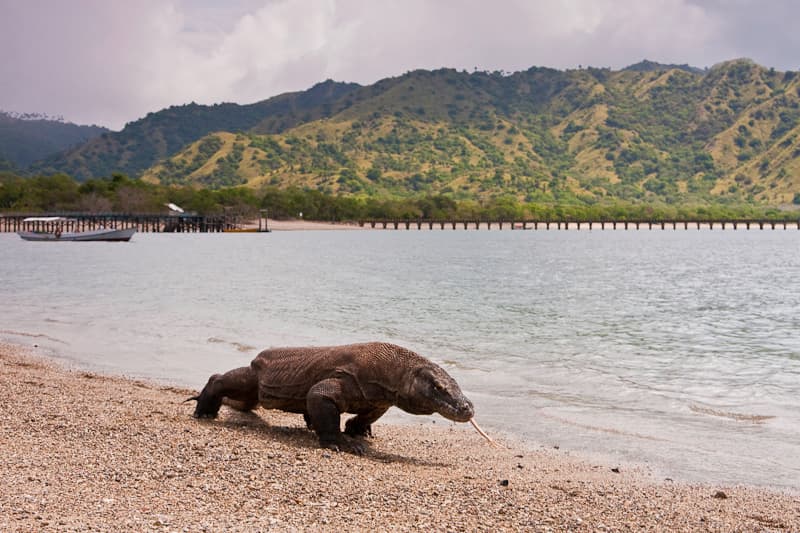
The Komodo dragon is the largest living lizard, confined to a handful of Indonesian islands. It hunts and scavenges using a combination of stealth, a serrated bite and venom components.
Interactive model
Characteristics
- 2–3 m (adult)
- ≈ 6.6–9.8 ft (adult)
- 70–90 kg (adult)
- ≈ 154.3–198.4 lb (adult)
- 25–40 years
- ≈ 25–40 years
Scale
Bars are proportional to a linear dimension (height or length). They are not mass. Human reference is 1.7 m.
- Komodo dragon2.5 m
- Average adult human1.7 m
- Family car1.5 m
- Double-decker bus4.4 m
Activity: Mostly diurnal
Taxonomy
Life stages
Hatchling
Arboreal and more insectivorous, reducing cannibalism risk.
Adult
Terrestrial ambush predator and scavenger of large vertebrates.
Adaptations
Venom and serrated teeth
Oral venom glands and a tearing bite help subdue prey; the old 'bacteria only' story is incomplete.
Behaviour
Eats deer, pigs and carrion; large meals may be followed by long rest.
Habitat and range
- Asia (native)
Conservation
Endangered
Population trend: Decreasing
Assessment year 2019 (curated, not live).
- Climate-driven habitat loss
- Human encroachment
Source: Varanus komodoensis. The IUCN Red List of Threatened Species
Compare
Sources
- Varanus komodoensis. The IUCN Red List of Threatened Species — conservation
- Varanus komodoensis on Animal Diversity Web or equivalent secondary literature — measurement
- Varanus komodoensis on Animal Diversity Web or equivalent secondary literature — text
Photograph: Adhi Rachdian, Wikimedia Commons, CC BY