Invertebrate · Herbivore · Grassland and meadow
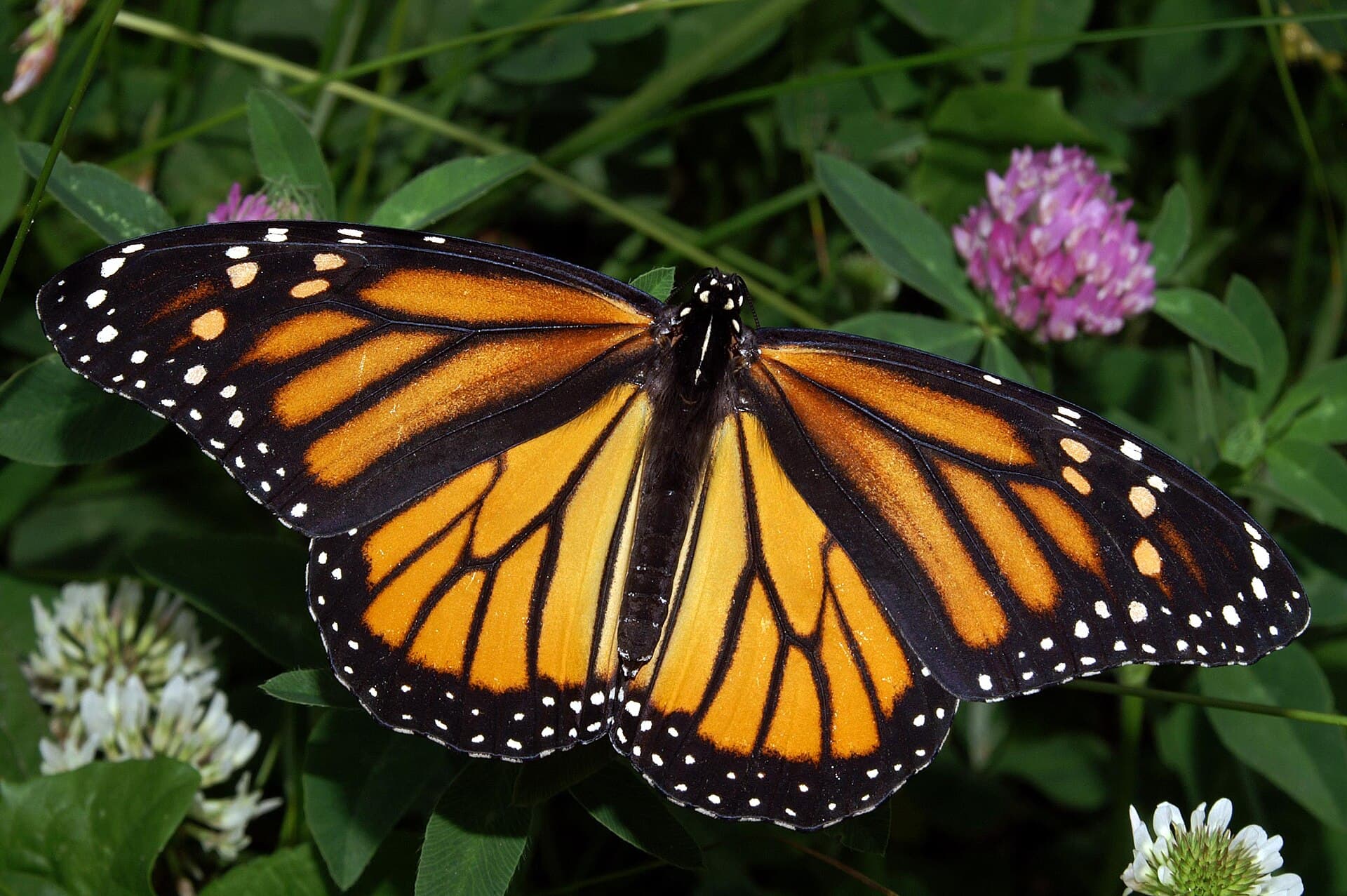
Monarch butterfly
Danaus plexippus
The monarch is a milkweed specialist with a four-stage holometabolous life cycle. In North America, successive generations fuel a long-distance autumn migration to overwintering forests. Wing colour advertises chemical defences sequestered from larval host plants.
Interactive model
Characteristics
- 0 kg (adult)
- ≈ 0 lb (adult)
- 0.1 m (adult)
- ≈ 0.3 ft (adult)
- 0.1–0.1 m (adult)
- ≈ 0.3–0.3 ft (adult)
- 0.1–0.7 years
- ≈ 0.1–0.7 years
Approximate adult mass; individuals vary with fat load.
Forewing length is smaller; value is a typical wingspan-scale body length proxy.
Summer adults live weeks; migratory adults may live several months.
Scale
Bars are proportional to a linear dimension (height or length). They are not mass. Human reference is 1.7 m.
- Monarch butterfly0.1 m
- 2 pence coin0 m
- Human hand0.2 m
- Average adult human1.7 m
Activity: Mostly diurnal
Taxonomy
Life stages
Egg
0–0.02 year
Pale eggs are laid singly on milkweed. This stage is measured in days, not years.
Larva
0–0.04 year
The caterpillar feeds almost exclusively on milkweed, sequestering cardenolides.
Pupa
0–0.04 year
A jade-green chrysalis in which larval tissues are reorganised into the adult.
Adult
0–0.08 year
Nectar-feeding butterfly. Migratory generation adults can live substantially longer than summer generations.
Adaptations
Chemical defence from milkweed
Larvae sequester cardenolides from host plants. The orange-and-black adult pattern is widely interpreted as a warning signal to visually hunting predators.
Migratory generation physiology
Autumn adults delay reproduction, build fat reserves and orient over long distances — a different life-history strategy from summer generations.
Behaviour
Larvae eat milkweed; adults take nectar and are important seasonal pollinators of garden and wild flowers.
Eastern North American populations undertake a multi-generational round trip involving Mexican overwintering sites.
Females search for milkweed and lay eggs singly; there is no parental care after oviposition.
Habitat and range
- North America (native)
- Central America (migratory)
Regions
- North America
- Central America
Simplified North American migratory corridor, not roost-level data.
Conservation
Endangered
Population trend: Decreasing
Assessment year 2022 (curated, not live).
- Milkweed and nectar-plant loss
- Overwintering habitat degradation
- Pesticides
Habitat restoration along migratory pathways and protection of overwintering forests are the main levers.
Source: Danaus plexippus. The IUCN Red List of Threatened Species
Compare
Sources
- Danaus plexippus. The IUCN Red List of Threatened Species — conservation
- Danaus plexippus monarch — measurement
- Danaus plexippus monarch — text
Photograph: Kenneth Dwain Harrelson, Wikimedia Commons, CC BY-SA