Bird · Carnivore · Cliffs and open country
Peregrine falcon
Falco peregrinus
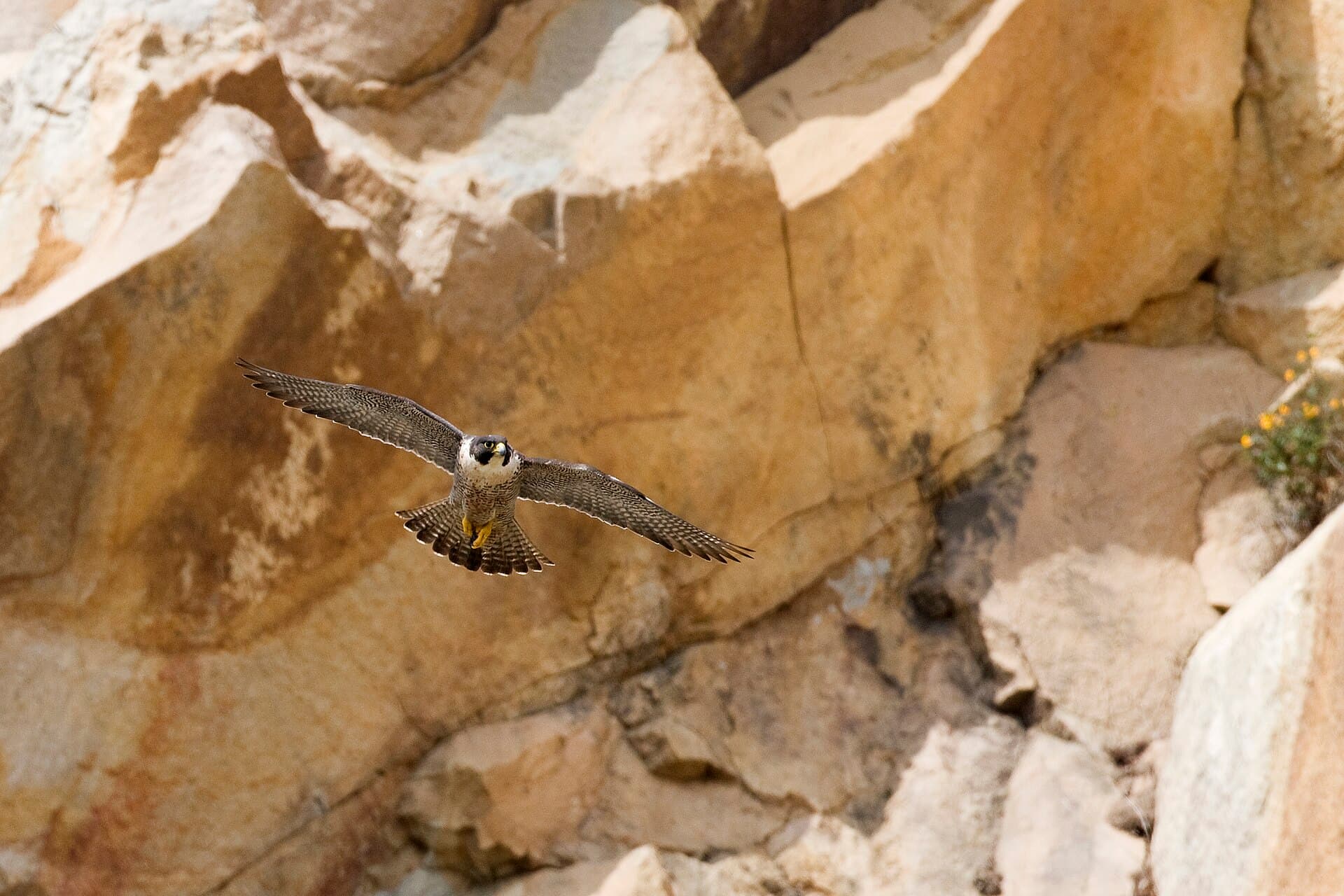
The peregrine falcon is a cosmopolitan bird of prey famous for high-speed hunting stoops. Compact, pointed wings and a streamlined body reduce drag, while a notched beak helps dispatch avian prey. Populations recovered in many regions after organochlorine pesticides were restricted.
Interactive model
Characteristics
- 0.3–1.5 kg (adult)
- ≈ 0.7–3.3 lb (adult)
- 0.3–0.6 m (adult)
- ≈ 1.1–1.9 ft (adult)
- 0.7–1.2 m (adult)
- ≈ 2.4–3.9 ft (adult)
- up to 320 km/h (maximum recorded)
- ≈ up to 198.8 mph (maximum recorded)
- 13–20 years
- ≈ 13–20 years
Strong sexual size dimorphism; females are larger.
Hunting stoop; not level-flight cruising speed.
Scale
Bars are proportional to a linear dimension (height or length). They are not mass. Human reference is 1.7 m.
- Peregrine falcon0.5 m
- Basketball0.2 m
- Domestic cat0.3 m
- Average adult human1.7 m
Activity: Mostly diurnal
Taxonomy
Life stages
Egg
0–0.1 year
Clutches are typically laid on cliff ledges or tall structures; incubation is shared.
Nestling
0–0.12 year
Downy young remain at the nest and are fed dismembered birds by both parents.
Juvenile
0–1 year
Brown-streaked plumage. Hunting skill develops over months after fledging.
Adult
1–∞ year
Slate-grey upperparts and barred underparts in typical plumage; established pairs may reuse nest sites.
Adaptations
Streamlined body and pointed wings
A compact torso and long, tapered wings reduce drag during a stoop, allowing the bird to convert altitude into very high airspeed when intercepting prey.
Bony tubercles in the nostrils
Structures in the nares are thought to moderate airflow during extremely fast dives, helping the bird breathe while the airspeed would otherwise be disruptive.
Behaviour
Specialises in catching birds in flight, often from a high perch or soaring vantage.
Pairs defend nest cliffs or urban nest sites during the breeding season.
Some populations are sedentary; others make long-distance seasonal movements.
Habitat and range
- Cosmopolitan (native)
- North America (native)
- Europe (native)
- Africa (native)
- Asia (native)
- Oceania (native)
Regions
- Cosmopolitan
- North America
- Europe
- Africa
- Asia
- Oceania
Illustrative worldwide box only. The species is nearly cosmopolitan; this is not a precise range map.
Conservation
Least Concern
Population trend: Increasing
Assessment year 2021 (curated, not live).
- Historical pesticide-related eggshell thinning
- Collisions with built structures
Legal protection and bans on certain pesticides supported a widely documented recovery.
Source: Falco peregrinus. The IUCN Red List of Threatened Species
Compare
Sources
- Falco peregrinus. The IUCN Red List of Threatened Species — conservation
- Falco peregrinus peregrine falcon — measurement
- Falco peregrinus peregrine falcon — text
- AnAge entry for Falco peregrinus — measurement
Photograph: Kevin Cole, Wikimedia Commons, CC BY