Mammal · Carnivore · Sea ice
Polar bear
Ursus maritimus
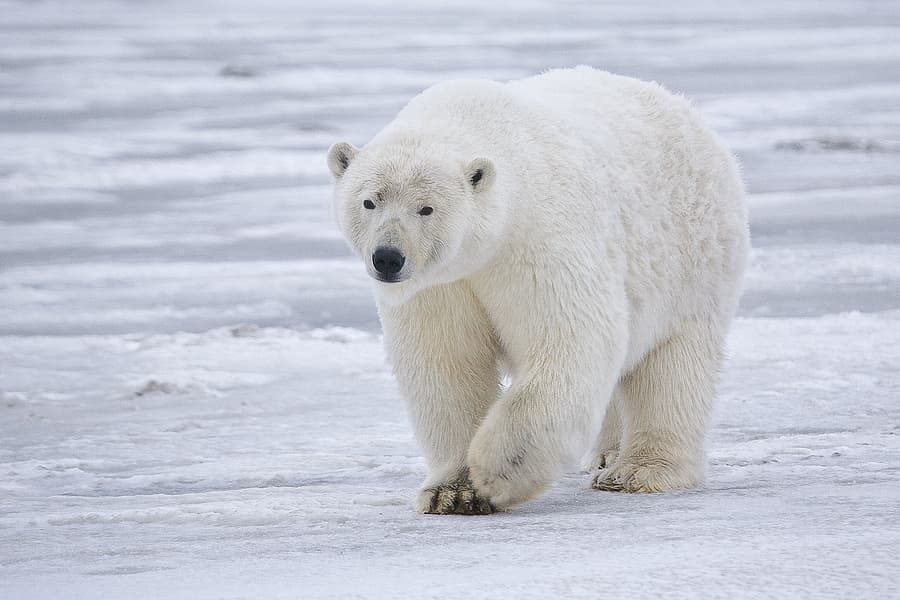
The polar bear is a marine mammal of the Arctic sea-ice ecosystem. It hunts seals at breathing holes and ice edges; sea-ice loss is the central conservation pressure.
Interactive model
Characteristics
- 150–800 kg (adult)
- ≈ 330.7–1,763.7 lb (adult)
- 2–3 m (adult)
- ≈ 6.6–9.8 ft (adult)
- up to 40 km/h (maximum recorded)
- ≈ up to 24.9 mph (maximum recorded)
- 20–30 years
- ≈ 20–30 years
Strong sexual dimorphism.
Scale
Bars are proportional to a linear dimension (height or length). They are not mass. Human reference is 1.7 m.
- Polar bear2.5 m
- Average adult human1.7 m
- Double-decker bus4.4 m
- Two-storey house8 m
Activity: Cathemeral
Taxonomy
Life stages
Cub
Born in snow dens; twins are common; they stay with the mother for more than two years.
Subadult
Independent but still learning to hunt on shifting ice.
Adult
Solitary except for mating and family groups of females with cubs.
Adaptations
Fur and fat insulation
Dense fur and a thick adipose layer reduce heat loss in water and wind. Dark skin beneath translucent hair absorbs solar radiation.
Behaviour
Primarily hunts ringed and bearded seals from sea ice.
Females fast in dens while nursing cubs, then lead them onto the ice.
Habitat and range
- Arctic (native)
Conservation
Vulnerable
Population trend: Decreasing
Assessment year 2015 (curated, not live).
- Sea-ice loss
- Pollution
- Human disturbance
Source: Ursus maritimus. The IUCN Red List of Threatened Species
Compare
Sources
- Ursus maritimus. The IUCN Red List of Threatened Species — conservation
- Ursus maritimus on Animal Diversity Web or equivalent secondary literature — measurement
- Ursus maritimus on Animal Diversity Web or equivalent secondary literature — text
Photograph: Alan Wilson, Wikimedia Commons, CC BY-SA