Reptile · Carnivore · Mangrove and estuary
Saltwater crocodile
Crocodylus porosus
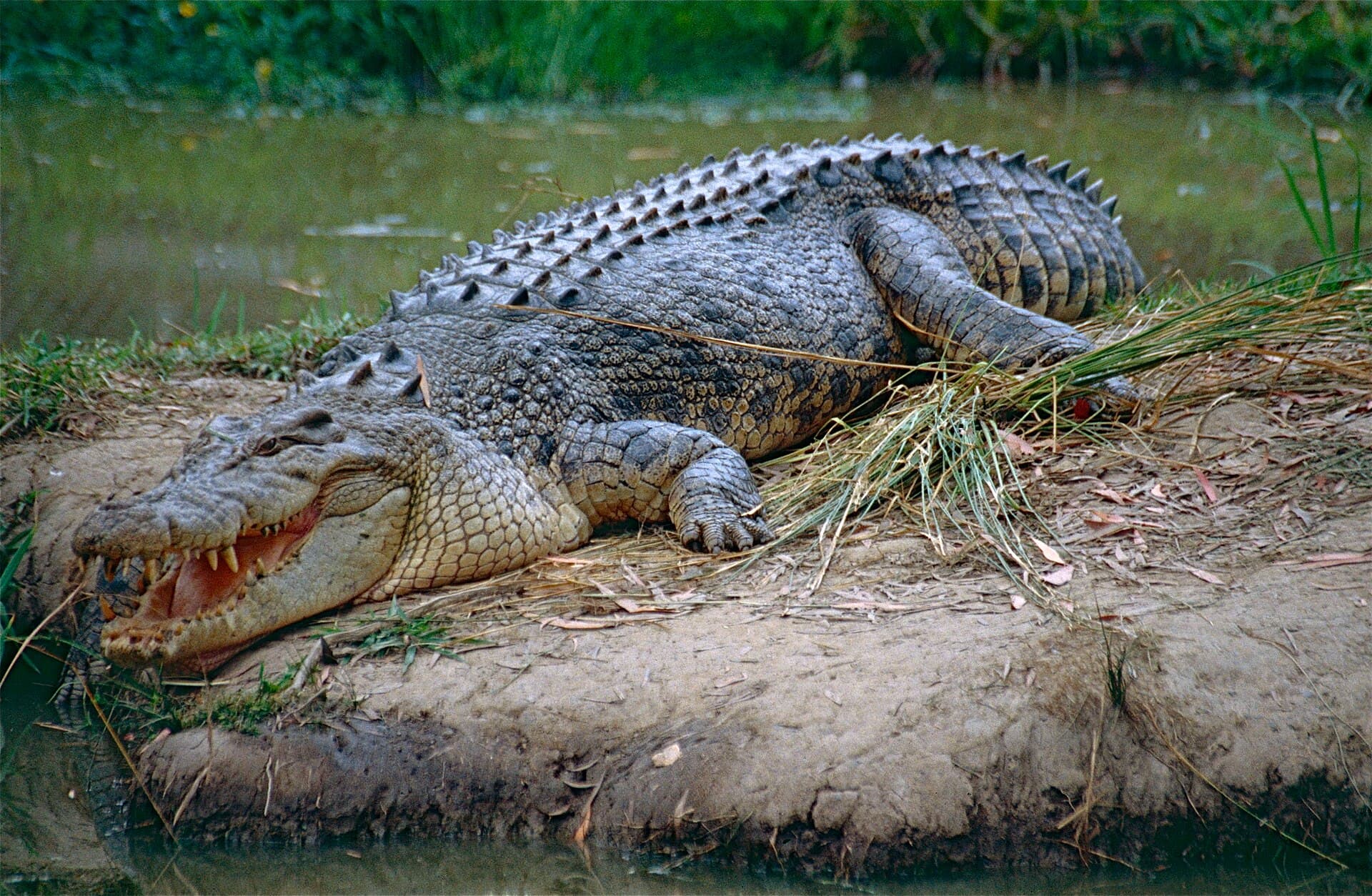
The saltwater crocodile is the largest living reptile. It occupies rivers, mangroves and coastal waters from South Asia to northern Australia and can travel at sea.
Interactive model
Characteristics
- 4–6 m (adult)
- ≈ 13.1–19.7 ft (adult)
- 400–1,000 kg (adult)
- ≈ 881.8–2,204.6 lb (adult)
- up to 29 km/h (maximum recorded)
- ≈ up to 18 mph (maximum recorded)
- 50–70 years
- ≈ 50–70 years
Short swimming bursts.
Scale
Bars are proportional to a linear dimension (height or length). They are not mass. Human reference is 1.7 m.
- Saltwater crocodile5 m
- Average adult human1.7 m
- Double-decker bus4.4 m
- Two-storey house8 m
Activity: Mostly nocturnal
Taxonomy
Life stages
Hatchling
Guarded after hatching; diet is invertebrates and small vertebrates.
Adult
Apex ambush predator capable of taking large mammals at the water's edge.
Adaptations
Salt-excreting glands
Lingual salt glands allow prolonged use of saline habitats that freshwater crocodiles tolerate less well.
Behaviour
Large males defend stretches of river; nesting females guard mounds.
Habitat and range
- Asia (native)
- Oceania (native)
Conservation
Least Concern
Population trend: Stable
Assessment year 2021 (curated, not live).
- Local hunting
- Habitat conversion
Source: Crocodylus porosus. The IUCN Red List of Threatened Species
Compare
Sources
- Crocodylus porosus. The IUCN Red List of Threatened Species — conservation
- Crocodylus porosus on Animal Diversity Web or equivalent secondary literature — measurement
- Crocodylus porosus on Animal Diversity Web or equivalent secondary literature — text
Photograph: Bernard DUPONT, Wikimedia Commons, CC BY-SA