Fish · Filter feeder · Marine
Whale shark
Rhincodon typus
The whale shark is the largest living fish. It filter-feeds on plankton and small fishes and is highly migratory. Despite its size it is not a hunter of large prey.
Interactive model
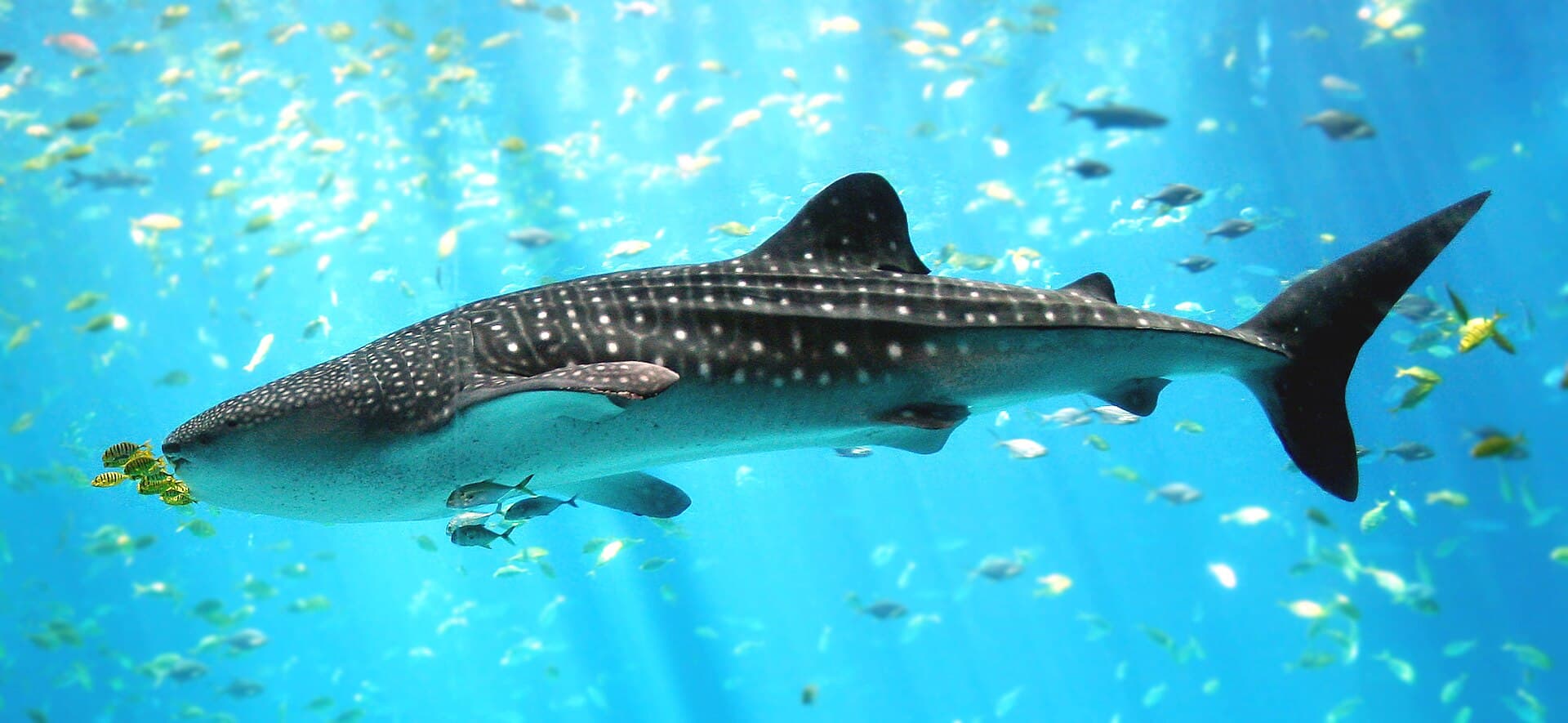
Characteristics
- 8–12 m (adult)
- ≈ 26.2–39.4 ft (adult)
- 9,000–20,000 kg (adult)
- ≈ 19,841.6–44,092.5 lb (adult)
- 70–100 years
- ≈ 70–100 years
Scale
Bars are proportional to a linear dimension (height or length). They are not mass. Human reference is 1.7 m.
- Whale shark10 m
- Average adult human1.7 m
- Double-decker bus4.4 m
- Two-storey house8 m
Activity: Mostly diurnal
Taxonomy
Life stages
Juvenile
Poorly known early life; neonates are rarely observed.
Adult
Aggregates at seasonal feeding sites rich in plankton.
Adaptations
Gill raker filter
Modified gill rakers strain tiny prey from huge volumes of water as the shark ram- or suction-feeds.
Behaviour
Filter feeding at the surface or in the water column; not a mammalian predator.
Habitat and range
- Tropical oceans (native)
Conservation
Endangered
Population trend: Decreasing
Assessment year 2016 (curated, not live).
- Bycatch
- Vessel strikes
- Directed fisheries
Source: Rhincodon typus. The IUCN Red List of Threatened Species
Compare
Sources
- Rhincodon typus. The IUCN Red List of Threatened Species — conservation
- Rhincodon typus on Animal Diversity Web or equivalent secondary literature — measurement
- Rhincodon typus on Animal Diversity Web or equivalent secondary literature — text
Photograph: Zac Wolf, Wikimedia Commons, CC BY_SA