Mammal · Carnivore · Tropical forest
Tiger
Panthera tigris
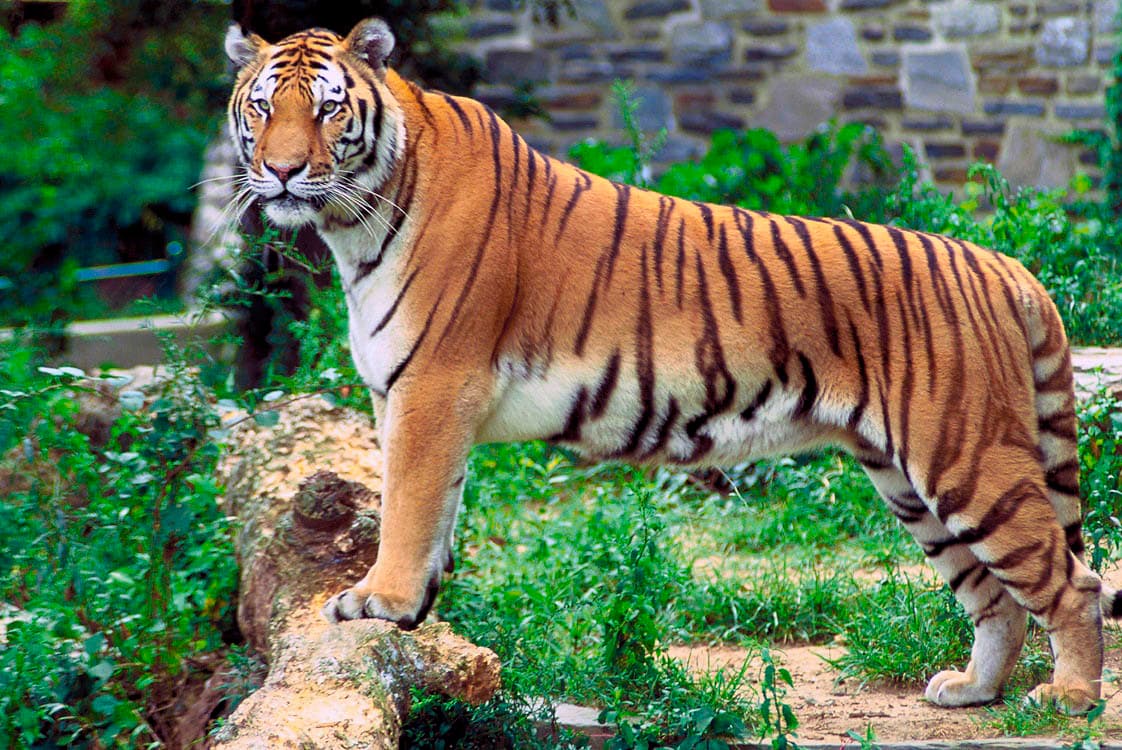
The tiger is the largest living cat, a solitary forest hunter of Asia. Stripe patterns are individual; remaining populations are fragmented across a fraction of the historical range.
Interactive model
Characteristics
- 65–260 kg (adult)
- ≈ 143.3–573.2 lb (adult)
- 1.4–2.8 m (adult)
- ≈ 4.6–9.2 ft (adult)
- 8–15 years
- ≈ 8–15 years
Mainland subspecies are larger than island forms.
Scale
Bars are proportional to a linear dimension (height or length). They are not mass. Human reference is 1.7 m.
- Tiger2.1 m
- Average adult human1.7 m
- Family car1.5 m
- Double-decker bus4.4 m
Activity: Crepuscular
Taxonomy
Life stages
Cub
Born in dens and dependent on the mother for more than a year.
Adult
Solitary adults hold large territories sized by prey density and sex.
Adaptations
Disruptive striping
Vertical stripes break up the outline in tall grass and dappled forest light, aiding ambush rather than open pursuit.
Behaviour
Takes deer, wild pig and other large ungulates; surplus killing is rare.
Scent marks and vocalisations advertise occupancy of a range.
Habitat and range
- Asia (native)
Conservation
Endangered
Population trend: Decreasing
Assessment year 2021 (curated, not live).
- Poaching
- Prey depletion
- Habitat fragmentation
Source: Panthera tigris. The IUCN Red List of Threatened Species
Compare
Related species
Sources
- Panthera tigris. The IUCN Red List of Threatened Species — conservation
- Panthera tigris on Animal Diversity Web or equivalent secondary literature — measurement
- Panthera tigris on Animal Diversity Web or equivalent secondary literature — text
Photograph: John and Karen Hollingsworth, USFWS, Wikimedia Commons, PUBLIC DOMAIN